Tejgaon, Dhaka-1215, Bangladesh | sales@uniqueintsg.com | +8801815-944073

PLC vs DCS vs SCADA: What Is the Difference?

Introduction
Industrial automation plays a vital role in improving productivity, operational efficiency, product quality, and workplace safety. Modern industries use automated control systems to monitor equipment, manage production processes, and maintain stable operating conditions.
Three widely used technologies in industrial automation are the Programmable Logic Controller (PLC), Distributed Control System (DCS), and Supervisory Control and Data Acquisition (SCADA) system.
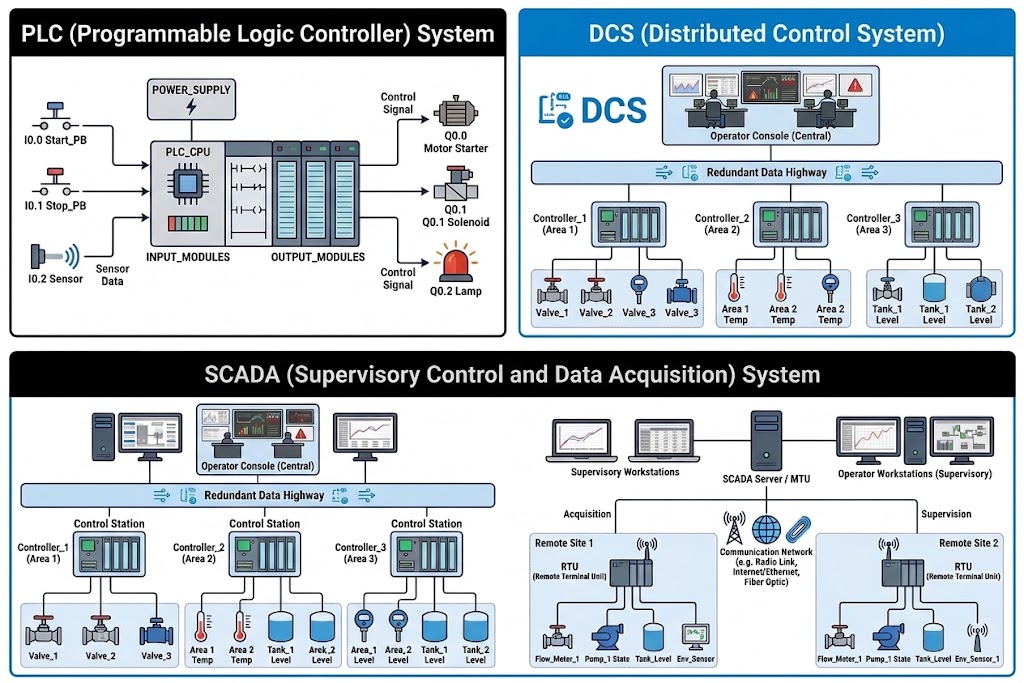
Although these technologies often work together, they serve different purposes. A PLC is commonly used for machine-level control, a DCS is designed for coordinated control of complex industrial processes, and SCADA provides supervisory monitoring and control across equipment and geographically distributed sites.
Quick overview: PLC handles control logic, DCS coordinates continuous industrial processes, and SCADA collects operational data and enables supervisory monitoring and control.
In this guide, we will explain the differences between PLC, DCS, and SCADA, compare their features, explore their industrial applications, and help you understand which system is suitable for different automation requirements.
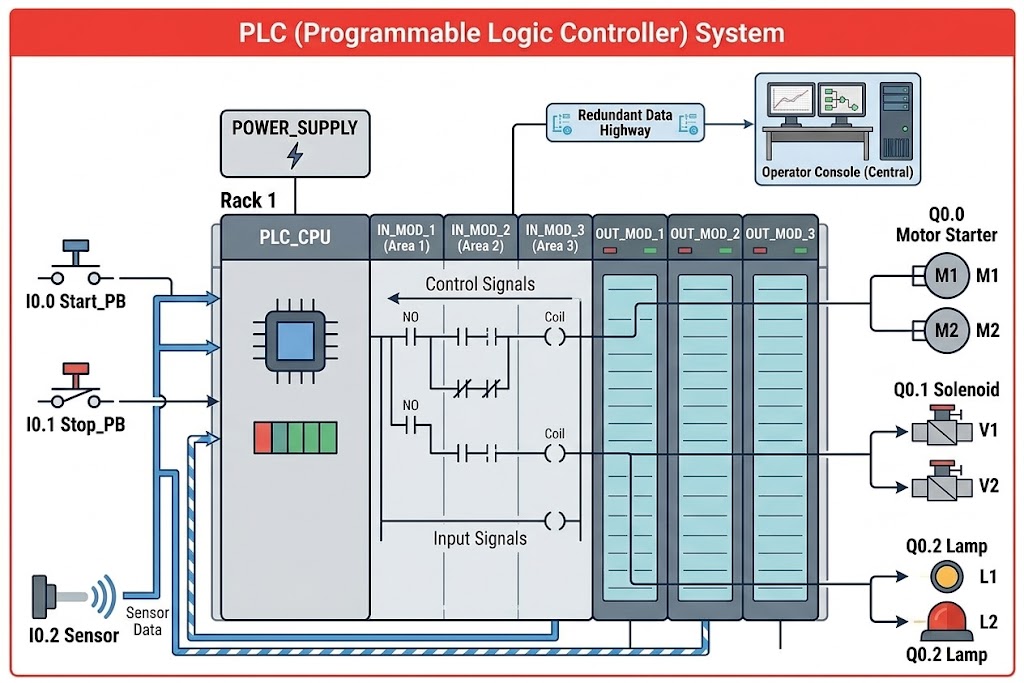
What Is a PLC (Programmable Logic Controller)?
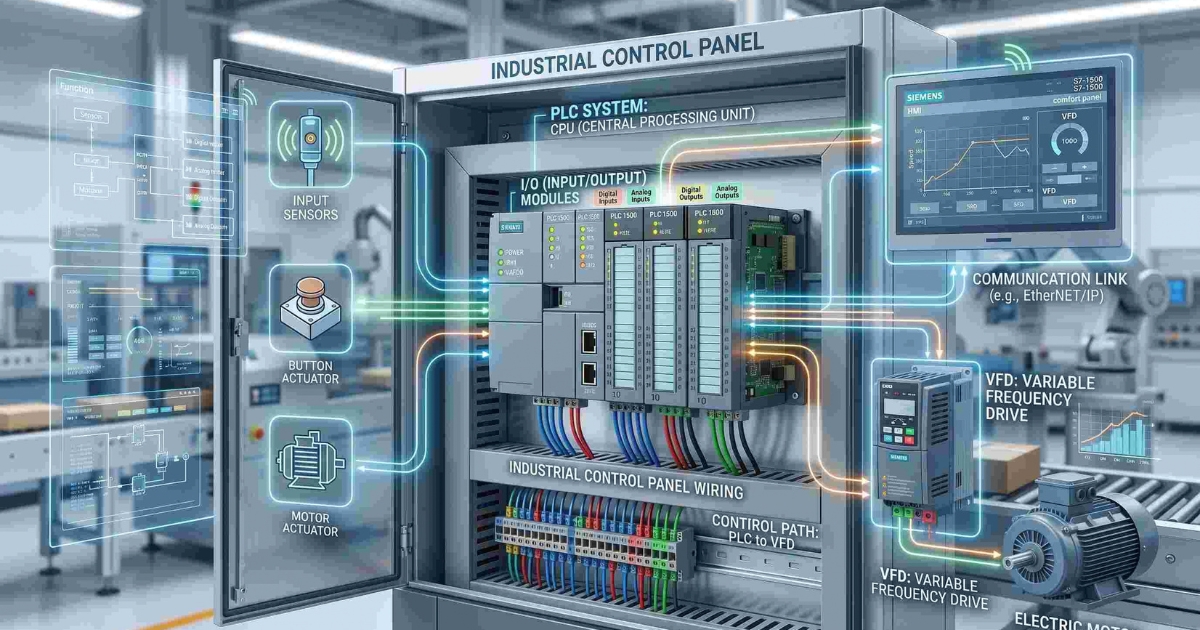
A Programmable Logic Controller (PLC) is an industrial digital controller designed to automate machines, equipment, and manufacturing operations. It receives input signals from sensors and switches, executes a programmed control sequence, and updates outputs connected to devices such as motors, valves, actuators, and relays.
PLCs are designed to operate reliably in demanding industrial environments. They are widely used in applications that require fast response, repeatable logic, dependable operation, and straightforward troubleshooting.
How Does a PLC Work?
A PLC generally operates through a repeating scan cycle:
- Input scanning: The PLC reads signals from connected sensors, switches, and other input devices.
- Program execution: The CPU executes the user-developed control program.
- Output updating: The PLC updates outputs according to the program logic.
- Communication and diagnostics: Depending on the system configuration, the PLC exchanges data with HMIs, drives, remote I/O, and other controllers.
Typical PLC control sequence
Sensor Input → PLC CPU → Output Signal → Machine Operation
Common PLC Programming Languages
PLC programs are developed using languages defined by the IEC 61131-3 standard. Common examples include:
- Ladder Diagram (LD): A graphical language resembling electrical relay logic.
- Function Block Diagram (FBD): Uses interconnected function blocks to represent control logic.
- Structured Text (ST): A text-based language suitable for calculations, conditions, and complex logic.
- Sequential Function Chart (SFC): Organizes sequential processes into steps and transitions.
Common PLC Applications
- Conveyor and material-handling systems
- Packaging and assembly machines
- Motor control and pump sequencing
- Industrial furnace and machine control
- Steel rolling mills and manufacturing equipment
- Water treatment equipment and utility systems
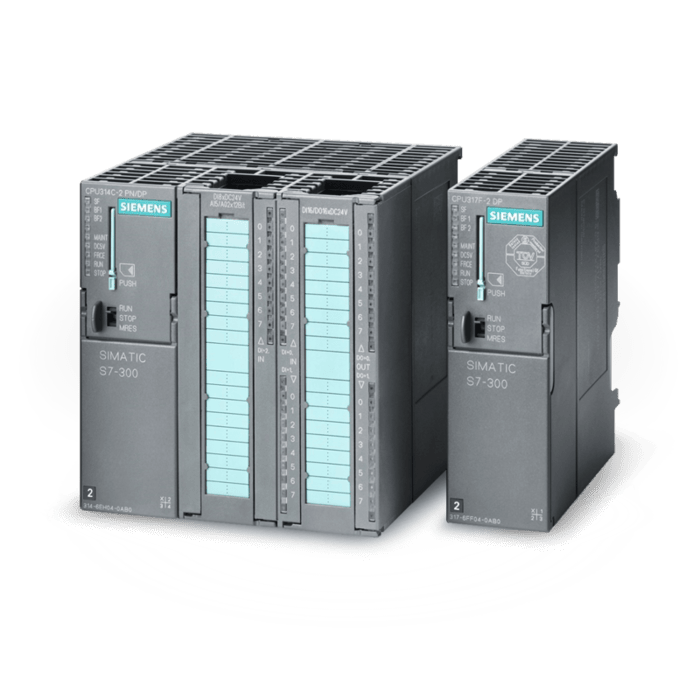
Examples of established PLC product families include Siemens SIMATIC S7, Allen-Bradley CompactLogix and ControlLogix, Schneider Electric Modicon, Omron PLCs, and Mitsubishi MELSEC controllers.
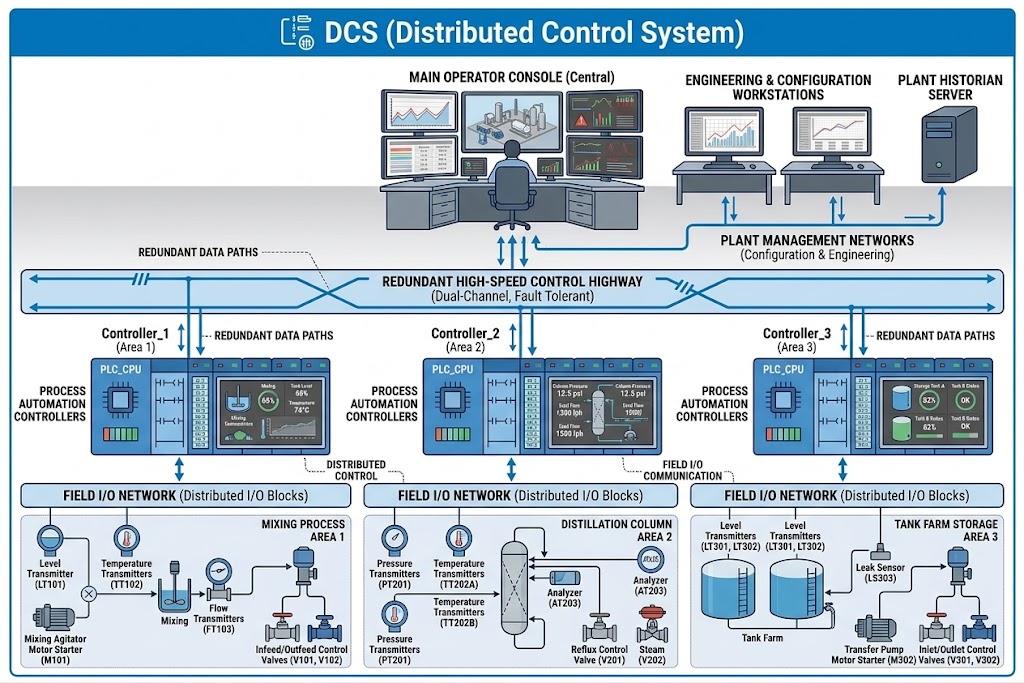
What Is a DCS (Distributed Control System)?
A Distributed Control System (DCS) is an industrial automation system designed to control and monitor complex processes through multiple interconnected controllers, I/O systems, operator stations, and engineering stations.
Unlike a control arrangement centered on a single controller, a DCS distributes control functions across different parts of a plant. This architecture is particularly suitable for large industrial facilities where many process variables and control loops must operate together.
How Does a DCS Work?
A DCS gathers information from field instruments, including temperature transmitters, pressure sensors, flow meters, and level transmitters. Its distributed controllers execute control strategies and send signals to field devices such as control valves, pumps, and other equipment.
Operators typically monitor the process through centralized operator stations, while engineers configure control strategies, alarms, trends, and system parameters using engineering tools.
Typical DCS architecture
Field Instruments → Distributed Controllers → Control Network → Operator Stations
Key Features of a DCS
- Distributed control across multiple process areas
- Integrated process monitoring and operator interfaces
- Advanced process control and PID loop management
- Alarm handling, event monitoring, and trend displays
- Coordination of multiple interconnected process units
- System redundancy options, depending on configuration
Common DCS Applications
- Oil and gas processing plants
- Petrochemical and chemical industries
- Power generation facilities
- Cement manufacturing plants
- Pharmaceutical production
- Pulp and paper manufacturing
Examples of DCS platforms include Siemens SIMATIC PCS 7 and SIMATIC PCS neo, ABB Ability System 800xA, Emerson DeltaV, Honeywell Experion, and Yokogawa CENTUM VP.
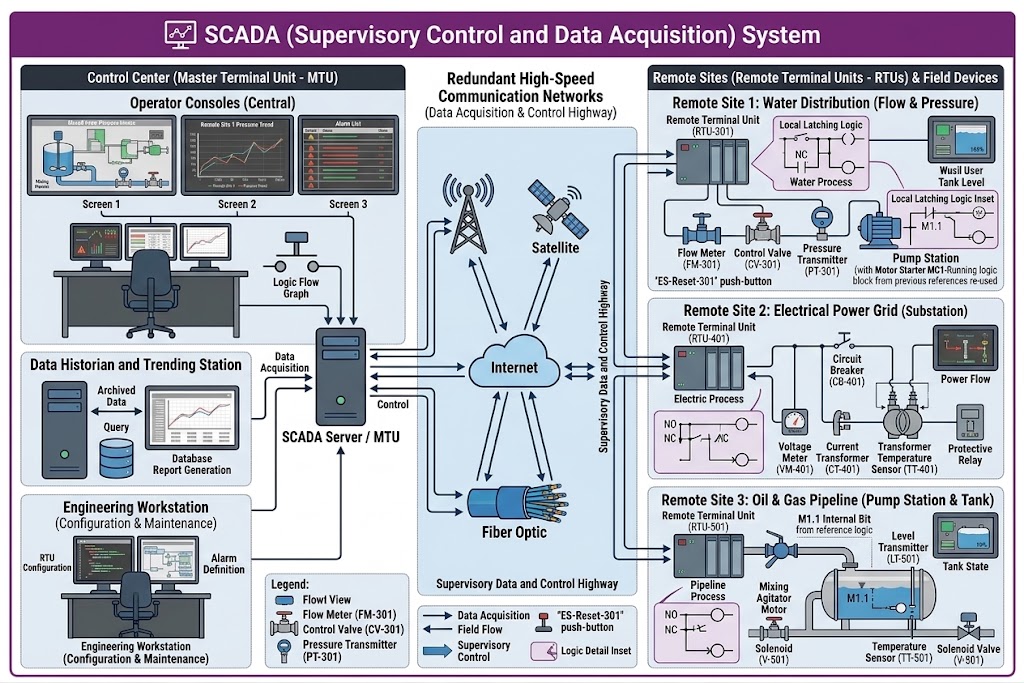
What Is SCADA (Supervisory Control and Data Acquisition)?
SCADA stands for Supervisory Control and Data Acquisition. It is an automation system used to collect, display, and manage operational data from industrial equipment and processes. SCADA systems allow operators to monitor equipment status, view measurements, respond to alarms, analyze trends, and issue supervisory commands.
SCADA is especially useful when equipment is spread across large facilities or geographically separated locations. For example, a water utility may use SCADA to monitor pumping stations, reservoir levels, flow rates, and treatment equipment from a central control room.
How Does SCADA Work?
Field instruments collect measurements and communicate with PLCs, remote terminal units (RTUs), or other control devices. These devices transmit relevant data to SCADA servers or supervisory computers. Operators then use graphical interfaces to monitor the process and, where permitted, issue commands.
Typical SCADA arrangement
Field Devices → PLC / RTU → Communication Network → SCADA Software → Operator
Key Features of SCADA
- Real-time and historical process monitoring
- Graphical human-machine interfaces and process overview screens
- Alarm and event management
- Data logging, trends, and reporting
- Supervisory commands to compatible control devices
- Communication with equipment across remote locations
Common SCADA Applications
- Water and wastewater treatment networks
- Electrical substations and power distribution
- Oil and gas pipelines
- Remote pumping stations
- Energy and utility monitoring
- Large industrial plants with geographically distributed assets
SCADA is primarily a supervisory monitoring and control layer. The actual control actions may be executed by PLCs, RTUs, DCS controllers, or other devices depending on the system architecture.
PLC vs DCS vs SCADA: Key Differences
The main difference between PLC, DCS, and SCADA is their primary role in an industrial automation system. A PLC executes control logic, a DCS coordinates control across complex processes, and SCADA provides supervisory monitoring, data acquisition, and operator control.
| Feature | PLC | DCS | SCADA |
|---|---|---|---|
| Primary purpose | Machine and equipment control | Integrated process control | Supervisory monitoring and data acquisition |
| Typical scope | Individual machines or control units | Large integrated process plants | Local or geographically distributed assets |
| Control execution | Executes programmed logic directly | Distributed controllers execute process control | Usually supervises controllers and field devices |
| Operator interface | Often a local HMI or connected supervisory system | Typically integrated operator stations | SCADA screens, alarms, trends, and reports |
| Typical applications | Packaging, conveyors, machines, motor control | Chemical plants, refineries, power plants | Utilities, pipelines, remote pumping stations |
| System design | Modular controller-based architecture | Integrated distributed control architecture | Supervisory software with communication infrastructure |
| Can work with the others? | Yes | Yes | Yes |
Important: These are general distinctions, not strict limitations. Modern PLCs, DCS platforms, and SCADA software can share some functions. The right choice depends on process complexity, control requirements, system size, reliability, integration, and lifecycle cost.
PLC vs DCS: What Is the Difference?
PLCs and DCS platforms both perform industrial control, but they are commonly selected for different types of applications.
PLC: Machine-Level Control
A PLC is often selected when an application requires dependable logic execution, fast responses, flexible I/O, and straightforward machine integration. It is widely used for discrete operations such as sequencing, interlocking, material handling, and equipment control.
- Well suited to machine automation and discrete control.
- Can be expanded with suitable modules and communication interfaces.
- Often integrates with drives, sensors, actuators, and HMIs.
- Can perform process control when appropriately designed and configured.
DCS: Integrated Process Control
A DCS is commonly selected for complex continuous or batch processes where many control loops, process units, operator stations, alarms, and engineering functions must work together as an integrated system.
- Designed for coordinated control across process areas.
- Provides integrated process monitoring and operator functions.
- Supports large numbers of control loops and process variables.
- May provide redundancy and system-wide engineering features, depending on the platform.
Which should you choose? For an individual machine or production line, a PLC may be the most practical solution. For a large process facility requiring coordinated control across multiple interconnected units, a DCS may offer a more integrated approach.
PLC vs SCADA: What Is the Difference?
A PLC and SCADA system perform different but complementary roles. A PLC executes control logic, while SCADA provides a supervisory interface for monitoring operations, collecting data, managing alarms, and issuing authorized commands.
Main Differences
- PLC: Reads input signals, executes control logic, and updates outputs connected to equipment.
- SCADA: Displays process information, collects data, records events, and enables supervisory control.
- PLC: Commonly operates close to the machine or controlled process.
- SCADA: Can monitor multiple PLCs and RTUs through a communication network.
Example: Water Pumping Station
Consider a water pumping station. A PLC can start or stop pumps based on level switches, pressure measurements, interlocks, and programmed conditions. A SCADA system can display pump status, water levels, pressure readings, alarms, and historical trends to operators in a central control room.
This combination allows local control to continue according to the PLC program while SCADA provides a wider operational view. The exact behavior during communication failure depends on the system design.
DCS vs SCADA: What Is the Difference?
DCS and SCADA systems both provide monitoring and supervisory capabilities, but their traditional design priorities differ.
A DCS is typically built around integrated control of a process facility. SCADA is typically built around supervisory monitoring and control of equipment, often across multiple locations. In modern industrial systems, the capabilities can overlap considerably.
| Comparison | DCS | SCADA |
|---|---|---|
| Main focus | Integrated process control | Supervisory monitoring and data acquisition |
| Typical deployment | Large process facility | Local or geographically distributed sites |
| Control architecture | Distributed process controllers and integrated stations | Supervisory software communicating with control devices |
| Typical use | Refineries, chemical plants, power generation | Water networks, pipelines, utilities, remote assets |
In practical projects, the selection depends on the required control strategy, geographical coverage, communication infrastructure, availability requirements, integration needs, and the capabilities of the selected platform.
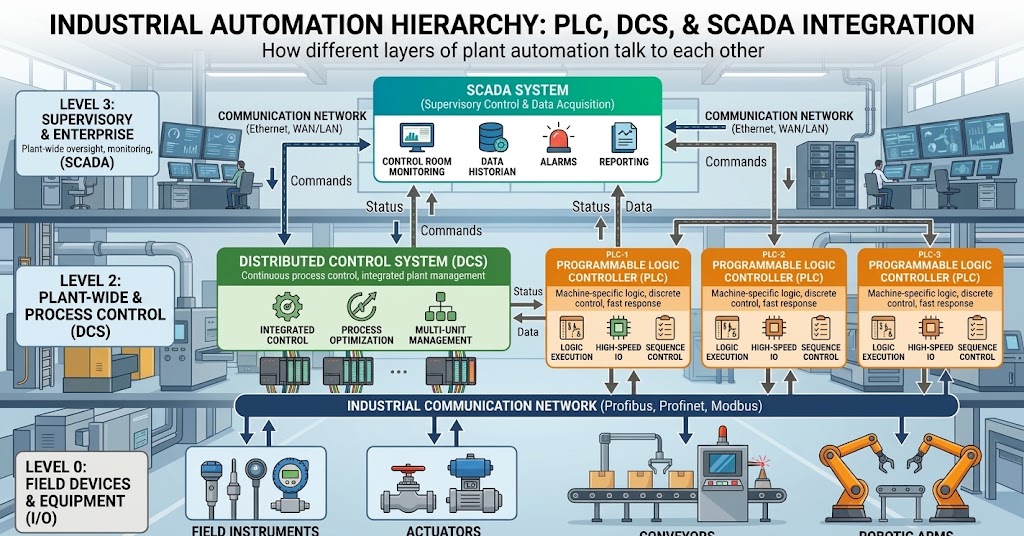
How PLC, DCS, and SCADA Work Together
PLC, DCS, and SCADA technologies do not always operate as separate alternatives. Many industrial facilities use combinations of these technologies to meet different control and monitoring requirements.
For example, a manufacturing plant may use PLCs to control individual machines, a SCADA system to supervise production equipment, and a DCS to manage a separate continuous process area. The final architecture depends on the size and complexity of the facility.
Example industrial automation architecture
Field Level: Sensors, transmitters, motors, valves, and actuators
Control Level: PLCs, RTUs, or DCS controllers execute control functions
Supervisory Level: SCADA or DCS operator stations display process information
Management Level: Approved systems may use production reports, historians, and business applications for analysis
For successful integration, engineers must consider communication protocols, network design, cybersecurity, alarm management, access permissions, and the behavior of the system when a device or communication link fails.
Industrial Applications of PLC, DCS, and SCADA
Different industries choose automation systems according to their process requirements, equipment layout, control complexity, and operational objectives.
PLC Applications
- Conveyor systems and material handling
- Packaging and assembly machines
- Motor, pump, and compressor control
- Industrial machinery and production lines
- Rolling mill auxiliary systems and equipment interlocks
DCS Applications
- Oil and gas processing
- Chemical and petrochemical production
- Power generation and boiler control
- Cement and pulp manufacturing processes
- Large continuous or batch process facilities
SCADA Applications
- Water and wastewater distribution networks
- Electrical substations and distribution monitoring
- Oil and gas pipelines
- Remote pumping and utility stations
- Monitoring equipment across multiple locations
These categories are general guidelines rather than fixed rules. A PLC may be used in a process plant, a DCS may include supervisory functions, and SCADA may monitor equipment controlled by either PLCs or other controllers.
Advantages of DCS
A DCS can provide an integrated approach to managing large and complex industrial processes.
- Distributed control: Control functions can be allocated across controllers serving different process areas.
- Integrated operator interface: Operators can monitor process conditions and manage alarms through coordinated operator stations.
- Process control capabilities: DCS platforms commonly support complex control loops, process sequences, and coordinated strategies.
- System-wide engineering: Configuration, diagnostics, and maintenance tools can be integrated across the control system.
- Scalability: The system can be designed to serve multiple process units and large numbers of field signals.
- Redundancy options: Supported redundant controllers, networks, or servers can improve availability when properly engineered.
DCS solutions are particularly useful when a facility needs coordinated process control, consistent operator workflows, and integrated engineering across many process areas.
Advantages of SCADA
SCADA systems help operators monitor and supervise industrial assets, especially when equipment is distributed across a large facility or multiple remote locations.
- Centralized monitoring: Operators can view information from multiple devices or sites through a common interface.
- Historical data: Configured data logging and trends help teams analyze operating conditions over time.
- Alarm management: Operators can receive notifications about abnormal conditions and equipment faults.
- Remote supervision: Authorized personnel can monitor and control compatible equipment from a central location.
- Reporting: Process data can support operational reports, maintenance planning, and performance analysis.
- System integration: SCADA software can communicate with compatible PLCs, RTUs, and other automation equipment.
SCADA is valuable for improving visibility across operations. Its effectiveness depends on reliable communications, appropriate system design, cybersecurity controls, and accurate field data.
Can a PLC Replace a DCS?
In some applications, a PLC-based control system can perform functions traditionally associated with a DCS. Modern PLCs can support analog process control, PID loops, communication networks, remote I/O, and integration with operator interfaces.
However, replacing a DCS with PLCs is not simply a matter of comparing controller specifications. The complete system must be evaluated, including engineering tools, operator stations, alarm management, redundancy, process coordination, maintenance requirements, and lifecycle costs.
Practical guidance: A PLC-based solution may be appropriate for smaller or less integrated process applications. A DCS may be preferable when a plant requires extensive process integration, standardized operator functions, and coordinated management of many control loops.
The final decision should be based on the process requirements, engineering assessment, safety requirements, reliability targets, and long-term maintenance strategy.
Can SCADA Replace a PLC?
Generally, SCADA does not replace a PLC because the two systems perform different roles. SCADA software provides supervisory monitoring and control functions, while the PLC executes the machine or equipment control logic.
For example, SCADA may allow an operator to issue a pump start command. The PLC can then check permissive conditions, interlocks, and programmed logic before operating the pump output. This arrangement helps keep essential control logic at the controller level.
Some automation platforms combine supervisory and control functions in different ways, but a SCADA interface alone should not be assumed to provide the real-time control capabilities, I/O handling, or deterministic behavior required from an industrial controller.
In most conventional architectures, SCADA and PLCs work together to provide both local control and centralized visibility.
PLC vs DCS vs SCADA: Which System Is Used Where?
The right automation system depends on the process, required response time, number of control points, geographical coverage, operator requirements, integration needs, and available budget.
| Requirement | Common Choice | Reason |
|---|---|---|
| Machine and equipment automation | PLC | Executes control logic and equipment interlocks. |
| Large continuous process plant | DCS | Coordinates many process control loops and operator functions. |
| Remote equipment monitoring | SCADA | Collects data and supports supervisory operation across sites. |
| Factory with multiple machines and central monitoring | PLC + SCADA | Combines local machine control with plant-wide visibility. |
| Large plant with process and machine areas | Combined architecture | Uses each technology where it best meets the requirements. |
For many industrial facilities, the best solution is not necessarily one technology alone. An integrated architecture can combine PLCs, DCS platforms, SCADA software, HMIs, drives, sensors, and industrial communication networks.
Frequently Asked Questions (FAQs)
1. What is the main difference between PLC, DCS, and SCADA?
A PLC executes control logic for machines and equipment. A DCS coordinates control across complex industrial processes. SCADA provides supervisory monitoring, data acquisition, alarms, trends, and operator control.
2. Is a PLC better than a DCS?
Neither is universally better. PLCs are commonly suitable for machine automation and equipment control, while DCS platforms are often selected for integrated control of large and complex process facilities. The best option depends on the application.
3. Is SCADA a controller?
SCADA is primarily a supervisory monitoring and control system, rather than a field controller. It normally communicates with PLCs, RTUs, DCS controllers, or other devices that execute the actual control logic.
4. Can PLC and SCADA work together?
Yes. PLCs commonly control machines and equipment, while SCADA collects data and presents process information to operators. The two systems communicate through compatible industrial networks and protocols.
5. Where is DCS commonly used?
DCS platforms are widely used in industries such as oil and gas, petrochemicals, chemical processing, power generation, cement manufacturing, and other facilities with complex process-control requirements.
6. Where is SCADA commonly used?
SCADA is commonly used for water distribution, wastewater treatment, electrical utilities, pipelines, remote pumping stations, and other operations that require centralized monitoring of equipment or geographically distributed assets.
7. Can a PLC be used for process control?
Yes. Modern PLCs can perform process-control functions, including PID control, when the selected controller, I/O, software, and system design meet the application’s requirements.
Conclusion: Understanding PLC vs DCS vs SCADA
PLC, DCS, and SCADA are important technologies in modern industrial automation, but each serves a distinct primary purpose. Understanding their differences helps engineers and industrial businesses select an appropriate control and monitoring architecture.
- PLC: Best known for machine-level control, sequencing, and equipment automation.
- DCS: Designed for integrated control and monitoring of complex industrial processes.
- SCADA: Provides supervisory monitoring, data acquisition, alarms, trends, and remote operational visibility.
In many industrial environments, these technologies complement one another rather than compete directly. The right solution depends on the application’s technical requirements, process complexity, reliability expectations, integration needs, and long-term operating costs.
Looking for Industrial Automation Equipment?
Unique International supplies industrial automation and electrical equipment for manufacturing and industrial applications. We can assist with PLCs, HMIs, VFDs, servo systems, industrial modules, sensors, actuators, valves and other automation components.
For product availability, model selection or technical assistance, please contact our team or submit a request for quotation.
Related topics: PLC programming, PLC programming languages, industrial automation, Siemens PLC, HMI, VFD, SCADA systems, DCS systems, industrial control systems.
< class="ct-module-title">
Trending now